

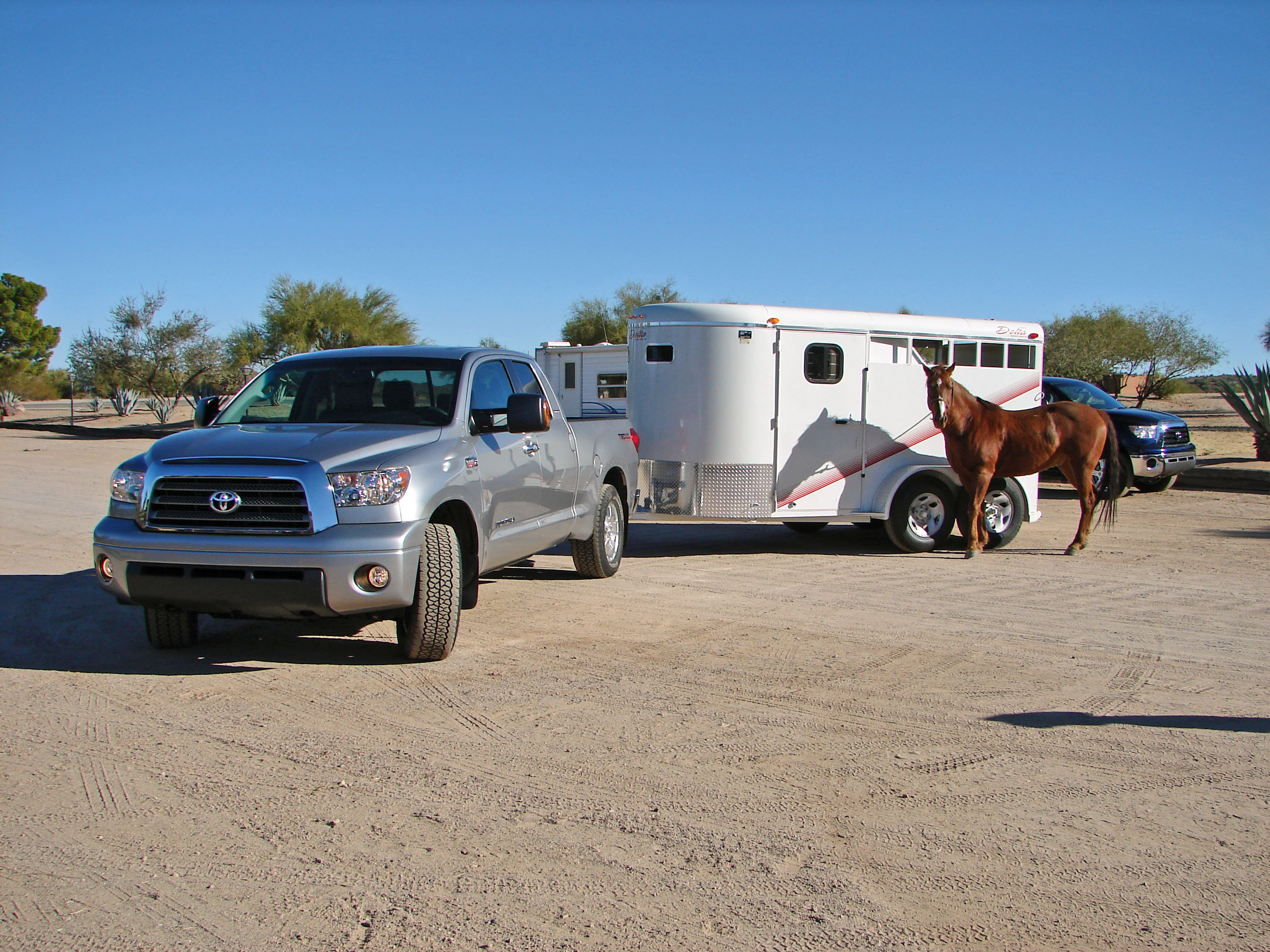
2007 Toyota Tundra review: bigger, better, fasterWow! All New Truck for 2007 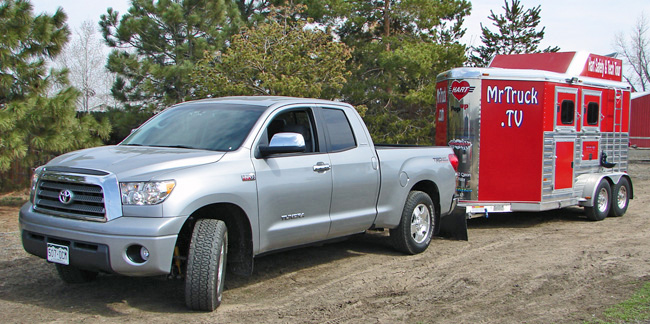 All new bigger, better, faster 2007 Toyota Tundra review 2007 Tundra Full size is for Towing. 2007 Tundra introduced at the National Western Stock Show with appropriate name as the frozen Tundra during one of the coldest snowiest winters in Denver for over a decade. Nice for Toyota’s 50 anniversary to introduce a true full size truck. They came along way from the first Land Cruiser first sent to America. Coming very late to the full size truck market, Toyota has stepped to the front of the 1/2 ton class. Known as dependable, Toyota trucks may now set benchmarks for how full size trucks are designed. I’m impressed. All new bigger, better, faster 2007 Toyota Tundra review. Largest engine in the 1/2 ton class, only 6-speed auto, lowest gear ratio axle (4.30), largest brakes in 1/2 and 3/4 ton segment (13.9″ front and 13.6″ rear rotors), and Toyota fixed my complaints with longer wheelbase (up to 164.6″ now) and stronger frame. I would say this new Tundra, equipped properly, is the most capable trailering truck in the 1/2 ton class. Vehicle Stability Control comes on in 4×4. Something all trucks need to keep the rear from fishtailing without a load. 80 degree door openings and a limo size door on the CrewMax. GPS screen doubles for backup camera or without GPS, a smaller screen on the inside mirror. Seat thigh adjuster, telescoping tilt wheel and parallel parking sensors are superb. You might forget it’s a truck. Then Toyota made the interior cleaner with a static electricity cabin filter. Like what we’ve seen from Nissan when they introduced the Titan, Toyota will have a “truck champion” truck specialist to answer your questions at the dealership. Selecting truck options for towing trailers can be challenging. But get the tow package with the 5.7L, 6-speed automatic transmission which comes with towing mirrors, 4.30 axle ratio and the receiver hitch and the only thing you have to decide is which trailer brake controller to buy. With 5.5, 6.6 and 8 ft beds goosenecks will be possible on 2 out of 3 beds. 2007 Toyota Tundra review: bigger, better, faster My first impressions of driving the all new larger Tundra was great. I was surprised how much more power the truck has with the towing package and the 4.30 axle ratio verses the 4.10 standard ratio. The Tundra was quite and accelerated smoothly with little body roll from the torque. You have to concentrate to notice the transmission shifts. Rack and pinion steering was tight, limited slip axle worked at the start then the traction control kicked in my extreme test. If you are into burning rubber, turn the Vehicle Stability Control off. There are three modes with VCS; auto, auto limited slip and off. Front leg space is longer and wider than most trucks. The brakes are unbelievable as they should be as the largest brake rotors in a 1/2 or 3/4 ton truck.
The gated center console shifter is close enough to the center console to manually shift the auto comfortably. The steering wheel console shifter also has a manual shifting toggle switch. With a transmission temp gauge in the dash, other gauges and controls are well positioned for driving across Kansas non-stop. I just love the power telescoping steering wheel. In the past when I would tow trailers with the old Tundra and the 4.7L engine, it worried me running the engine at red-line most of the time. With the new 5.7L and 6-speed auto, I had more rpm band in reserve towing a trailer. This makes the truck quieter, improves towing mpg and gives you plenty of reserve power for passing and using the left lane in the mountains. Tire pressure monitoring is standard as it should be. Also standard 18″ wheels and limited slip. Tundra CrewMax Video with Andrew Coetzee CrewMax, the limo you can use everyday
Larger than the model it replaces, the 2007 Tundra is available in 31 model configurations. The 2007 Tundra offers three cab styles, three wheelbases, three bed lengths, three engines, and three trim levels. Cabs: Tundra offers three cab styles: Regular Cab, four-door Double Cab, and the super-sized four-door CrewMax. Tundra Regular Cab comes in DX trim level and can be upgraded to SR5 with an option package; the Double Cab and CrewMax models come in SR5 and Limited trim levels.Engines: Unusual engines with dual overhead cams and variable cam timing on both the intake and exhaust. These engine’s more advanced Dual VVT-i controls valve timing and overlap on both the intake and exhaust valves, which also helps optimize power, fuel efficiency and emissions. The 2007 Tundra offers three engines. In Regular and Double Cab models, a standard 4.0-liter V6 produces 236 horsepower at 5,200 rpm and 266 lb.-ft. of peak torque at 4,000 rpm. The mid-grade option for these models – and standard for the CrewMax models – is the proven Tundra’s 4.7-liter i-Force V8 producing 271 horsepower at 5,400 rpm and 313 lb.-ft. of peak torque at 3,400 rpm. The i-Force 5.7L V8 has an aluminum cylinder block and DOHC heads. The all-new 5.7-liter i-Force V8 is available in every model. The 5.7L uses a long-stroke (stroke dimension of 4.02 in. is more than the bore width of 3.70 in.). Producing 381 horsepower at 5,600 rpm, and 401 lb.-ft of peak torque at 3,600 rpm. Tundra models have city/highway fuel economy ratings of: 5.7L V8 4X2: City=16, Hwy=20 2007 Toyota Tundra review: bigger, better, faster Both the V6 and the i-Force 4.7 V8 feature DOHC 4-valve cylinder heads and Variable Valve Timing with intelligence (VVT-i) . Both engines are only available with a five-speed automatic transmission. Updated flex lock-up torque converter control improves transmission response and efficiency. Both the Tundra five and six-speed automatic features uphill / downhill shift logic. On all Tundra engines, the Acoustic Control Induction System (ACIS) uses butterfly valves inside intake manifold to switch the length of the intake tract in two stages, based on rpm and throttle angle, to improve torque across the engine speed range. Stainless steel headers flow into a stainless steel exhaust system with high-capacity mufflers with equal exhaust pipe lengths. The i-Force 5.7 and 4.7 have a crank-hold electronic starter control that uses a “twist and release” ignition switch I like. The Engine Control Module controls the starter relay to prevent failed starts and “grinding” on a re-start attempt. The 5.7L only comes with a new six-speed automatic transmission. Shift logic adapts the transmission’s shift patterns to the way you drive. Both Tundra transmissions use new Toyota “WS” (world-standard) fluid with a flat viscosity/temperature curve (cold viscosity is close to warm viscosity). This fluid reduces friction and wear, enables faster vehicle warm-up, and never needs to be replaced. The only thing I’m concerned about is the “no maintenance” auto tranny. Even if you want to service it, you can’t. No dipstick, which is becoming common, but no scheduled time to change oil or filter or pump screen or anything. I guess with the 60 month 60,000 mile drivetrain warranty, you won’t worry for a while. Toyota owners won’t give this a second thought, but the rest of us wonder. Of course if Toyota wants to send me a Tundra, I’d be more than glad to put a 100,000 towing miles on it just to prove the point. Frame. The six inch wider frame is boxed in the front section, reinforced C-channel under the cab and open C-channel under the bed. The reinforced sections are welded and riveted. While all the other 1/2 tons have boxed their frames from head to tail, Tundra stays C-channel. Good company with Ford Super Duties, and all the semi- trucks. There are three Tundra wheelbases: 126.8 inches for Regular Cab/standard bed models; 145.7 inches for Regular Cab/long bed, Double Cab/standard bed and CrewMax models, and a massive 164.6 inches for Double Cab/long bed models. 2007 Toyota Tundra review: bigger, better, faster
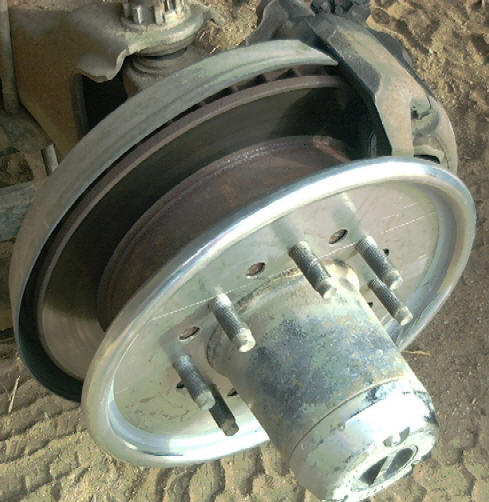
Compared to the previous Tundra, an increased tire-turning angle reduces the turning circle. The rear suspension features staggered shocks that are mounted outboard of the leaf springs like the Ford F150 to improve the shock’s dampening efficiency. The spring “toe-out” mounting improves towing stability. Bump stops above leaf springs act as an overload. Long leaf springs, picture at right. Brakes: The four-wheel disc brake system uses large ventilated rotors front and rear: the front rotors measure 13.9 inches in diameter and 1.26-inches thick, with four-piston calipers. The rear discs measure 13.6 x 0.71-inch and use two-piston calipers. Anti-lock brakes (ABS) with Electronic Brake-force Distribution (EBD) and Brake Assist (BA) are standard on all models. Notice the rear brake caliper is where it should be, on the back of the rotor (right pictures). Electronic Brakeforce Distribution optimizes brake pressure at each wheel for greater control under braking, especially when cornering. The Brake Assist system is designed to determine if the driver is attempting emergency braking, wow! If the driver has not pressed firmly enough on the brake pedal to engage the ABS, the system supplements the applied braking power until pedal pressure is released. Sounds like something on the Space Shuttle. Traction Control: The 2007 Tundra is equipped as standard equipment, Automatic Limited-slip Differential (A LSD). The combination of A-LSD and Vehicle Stability Control (VSC) is standard equipment. The Tundra’s VSC system integrates traction control (TRAC) on all models, and improves traction on or off-road by helping to keep the vehicle going on its intended direction. VSC detects front-wheel slide and rear-wheel slide during cornering and attempts to control either condition with throttle intervention and/or by braking individual wheels. Pickup trucks need this more than cars as they are unbalanced without a load in the bed. Controlled by a switch, “Normal” mode enables all traction and stability capability. “TRAC Off” activates A-LSD. The “VSC Off” mode turns off all of these systems. The V6 and i-Force 4.7 V8 Tundra models’ rear differential uses a 9.5-inch ring gear, and the i-Force 5.7 models step up to a 10.5-inch ring gear like a 3/4 ton. Safety: On the safety front, all Tundra models feature the STAR safety system as standard equipment. The STAR safety system includes ABS, Electronic Brakeforce Distribution (EBD), Brake Assist, Vehicle Stability Control (VSC) and Traction Control (TRAC). Tundra features standard front and rear seat side and roll-sensing side curtain airbags in all models. Towing: The optional Tow Package is available on all V8 models and is standard on Double Cab Long-Bed models. The Tow Package starts with a one-piece hydro-formed towing receiver integrated into the frame. The structure attaches to each side of the frame around the rear spring shackles’ frame cross-member with 12 bolts. Tow Package rear springs provide increased full-load rear suspension height. The Tow Package also upgrades Tundra’s cooling and electrical systems. A water-to-oil engine oil cooler speeds engine warm-up and reduces friction at startup. The automatic transmission fluid warmer, warms the fluid quickly under cold conditions, and the instrument panel gains an automatic transmission fluid (ATF) temperature gauge. A power steering fluid cooler is added below the radiator. Electrical upgrades include an under-dash connector pigtail for a trailer brake controller, both a seven-pin and a four-pin trailer brake connector near the hitch, and a higher output alternator (depending on engine). And of course a set of optional telescoping towing mirrors (available on 5.7-liter V8 models only). When the Tow Package is ordered for the 5.7-liter-equipped Tundra, its six-speed automatic transmission gains a TOW/HAUL shift mode, selectable by a dedicated switch. The TOW/HAUL shift mode applies specific logic for transmission upshift and downshift control, holding lower gears when accelerating or decelerating. Payload ranges from 1585 lbs on the CrewMax 4×4 to 2060 lbs on the 4×2 regular cab. Towing capacity ranges from 10,800 lbs on the 4×2 regular cab to 10,100 lbs on the 4×4 CrewMax.
Three Bed Sizes: Tundra Regular Cab and Double Cab models are offered in standard bed (78.7-inch) or long bed (97.6-inch) configurations; the CrewMax comes with a short bed (66.7-inch). In all models, the bed measures 22.2 inches deep. Like the Ford F150 from 2004, the bed is deep enough to be cautious with goosenecks and 5th wheel trailers. Measure your bedrail clearance. The Tundra’s new lockable all-steel tailgate, with tailgate assist helps with the tall tailgate. A cargo light is standard. A Deck Rail System, standard on Limited grade models is available on all others. Featuring adjustable tie-down cleats connected to the rails of the bed, the rail system can be used to secure loads, with a 220 lbs. rating per attachment. Bed management is close to my heart as cargo flying out of truck beds is a hazard for all of us that share the road. Front Office: Inside the new Tundra, the driver is surrounded by a U-shaped “command and control” center that helps provide an unobstructed view of the road and gauges, while keeping all knobs, switches and buttons close. Owners like MrTruck spend a lot of time in their trucks as mobile offices. The 3.4-liter upper glove box can hold a standard Thermos™ bottle, with additional space available in the 9.5-liter lower glovebox. Picture right, double glove box like 07 GM introduced. The center console on bucket-seat models can hold a laptop computer or hanging file folder storage. The center console armrest can slide four-inches. The Tundra has two 12v DC power outlets – one on the dash and one in the center console. CrewMax models add a third outlet at the rear of the center console. The outlets remain live for up to two hours after the ignition is switched off. Inside: The Double Cab features front-hinged doors that open to 80 degrees for easy passenger access. Tundra Double Cab models provide a 22-degree backrest angle and 34.7 inches of rear legroom. A 10-inch slide range for passengers or room for onboard cargo. CrewMax models provide additional storage under the rear seat. On Double Cab and CrewMax models, the standard power rear windows retract completely into the doors. The Regular and Double Cab models have a split sliding rear window. CrewMax has a power vertical slide-down rear window standard.
The Regular Cab DX and all SR5 grade models come standard with a versatile dual-zone manual climate control system with a seven-speed blower, sync-mode and a replaceable dust and pollen filter. In Limited grade models, the standard dual-zone automatic climate control system features upper/lower temperature control. 2007 Toyota Tundra review: bigger, better, faster
CrewMax models offer an optional Rear Seat Entertainment (RSE) system that combines a nine-inch wide-screen LCD monitor, DVD player, two sets of wireless headphones and a remote control. Warranty: Toyota’s 36-month/36,000-mile basic new-vehicle limited warranty applies to all components other than normal wear and maintenance items. Additional 60-month warranties cover the powertrain for 60 months/60,000 miles and corrosion perforation for 60 months with no mileage limitation.
|
Light-Duty shootout with 2009 PickupTrucks.com and MrTruck.com
2007 GM Heavy Duty pickup trucks






 Automatic Tire Balancers for Trucks and Trailers25% to 50% longer tire life,
  Automated Safety Hitch




 Popup Cushion Coupler Happy Horses Smooth Trailers